Technology News

Saturday, 4 May 2013

Can't afford Google Glass? Make your own like this guy did


Don’t want to wait another year for Google Glass to drop? Or perhaps you didn’t have $1,500 to spare when the Explorer edition kits were available for pre-order last year? Apparently neither did an Australian techie so he did the next best thing – made his own. Meet Flass, Google Glass’ Australian brother.
Ok, so it’s nowhere nearly as refined as the real thing but that doesn’t mean it’s any less impressive. OCAU forum member Ash_Williams designed Flass from the ground up to be a clone of Google Glass. The name, if you hadn’t already figured out, is a play on the words “fake” and “glass.”
The device is powered by a Samsung Galaxy S i9000 which feeds the display using TV-out to a MyVu Crystal 701. There’s also a Bluetooth keyboard and a Bluetooth earpiece – all mounted on a pair of standard looking glasses. The designer said he hopes to ultimately use a Raspberry Pi to power the unit instead of the phone so screen power isn’t an issue.
The kit will soon be receiving an upgrade, however, as he has a 3D-printed Google Glass frame on the way to use for reference to build an everyday version. The most recent post in the thread (dated May 2) noted that the thread would be updated sometime next week once the Glass replica is in. Additional plans for a future revision include integrating a camera into the system and refining the user interface a bit.

Robotic insect takes first flight, barely weighs more than grain of rice


Researchers toiling away in a Harvard University lab have developed what is said to be the world's most miniscule, guided, flying robot. Weighing just under three thousandths of an ounce, RoboBee with its 3cm wingspan borrows heavily from real flying insects -- particularly flies -- to become airborne.
One of the primary enigmas RoboBee posed to researchers was how to build electromechanical components both truly tiny and capable of sustaining flight. The device required parts that were too fine for traditional mechanisms like gears and pistons; RoboBee was also too small for most common silicon-based components, as well.
Instead, the team developed its own techniques to produce teensy weensy electromechanical components. Harvard researchers coined these parts as SCMs, or smart composite microstructures and they are derived from strong and ultra-light carbon composites. 
"It's really only because of this lab's recent breakthroughs in manufacturing, materials, and design, that we have even been able to try this." one researcher noted. He later added, "This is what I have been trying to do for literally the last 12 years".
RoboBee's ethereally-thin wings beat an astonishing 120 times per second. To achieve this feat, a specially designed ceramic-based piezoelectric material was used. The substance expands and contracts when voltage is applied and removed, mimicking how a real muscle might work. As an added bonus, the system provides the pint-sized insectdroid with astonishing maneuverability -- it can hover and make sudden changes in its position.
Before readers succumb to horrifying visions of a dystopian future where weaponized insect armies are saddled with high-tech surveillance equipment, it's important to know that this insect-inspired robot is still tethered to a wire for power. RoboBee is so small and so light, it likely can't support the weight of both a useful camera and battery pack. This also suggests we won't see laser cannons mounted on RoboBee in the immediate future. But with promising battery technologies lurking around the corner, its certainly not an impossibility. 
A "fully flying wireless robot" is a just "few more years" away, researchers project.

Staples becomes first major US retailer to sell 3D printer


Interested in a fancy new 3D printer but don’t know where to start? Just hit the easy button – as in, Staples. That’s because the company today became the first major US retailer to start selling a 3D printer. You can now order The Cube by 3D Systems on Staples.com for around $1,300 or if you’d rather see it in person first, head to your local Staples retail store starting next month.
The Cube is one of a number of 3D printers designed with traditional consumers in mind. Specifically, this unit can print items up to 5.5 inches tall, wide and long in one of 16 different colors. The retail bundle includes 25 free design templates to get users started but the real fun is designing and building something all your own.
Perhaps the most widely known 3D printer is the Replicator 2x from MakerBot. This piece of machinery made its debut at the Consumer Electronics Show earlier this year and has since earned a reputation as the go-to device for home 3D printing.
The company recently partnered with open-source Android gaming console maker Ouya to let gamers print custom 3D console cases at home. The $2,800 price tag, however, may be a bit too much for some to stomach which gives products like The Cube an excellent inroad into the market.
Share value in 3D Systems was up four percent following the announcement while Staples stock was up three percent.

Friday, 3 May 2013

Far Cry 3: Blood Dragon Review

Far Cry 3: Blood Dragon Review


In an age where the search for deeper meaning in our interactive entertainment pursuits begins after the first trailer — where more thought goes into post-game critical analysis than development — a game that bears its shallow soul for all to see is a blessing. "The game is stupid," Far Cry 3: Blood Dragon creative director Dean Evans proudly proclaimed during a recent press event — not foolish pride, but pride in foolishness.
"Dare to be stupid," sang parody artist Weird Al Yankovick in a song appearing in the 1986 animated Transformers movie, a contemporary to the late 80s, early 90s action films from which this day-glo Far Cry 3 spin-off takes much of its inspiration. As a young teen I enjoyed the tune in the same way I enjoyed movies like Terminator and Aliens (both featuring Michael Biehn, the voice of Blood Dragon's protagonist) — mindless fun.
The game casts players as Sergeant Rex 'Power' Colt, a name we wouldn't have blinked an eye at back in 86. He's a special forces cyborg with a man to kill, but first he's going to have to kill all of the things standing between him and that man. The game's loosely about saving the world. Heck, if we were in the 80s it might have been heralded as a commentary on the Cold War. We were pretty ridiculous in the 80s.
The story unfolds through a series of 2D cutscenes that wouldn't be out-of-place in an NES-era adventure (well, except for the foul language and... other things). And when those scenes end, it's into a day-glo nightmare from the early days of MTV.
If a black light poster broke open a neon bar sign and inhaled its contents, this would be what the puddle of vomit around its corpse would look like when the police found him. It was nice and novel for the first couple of hours, but I soon found myself yearning for the cloudy blue skies of Far Cry 3 proper.
Ubisoft has done great and terrible things with the game engine, transforming it into a nightmare world, where wild boars roam the purple plains, backs covered with neon graffiti. Where mutated gila monsters — the eponymous blood dragons — prowl the tiny island, seeking to make a meal of whatever flesh your cyborg body still possesses.
As outlandish and garish as this tiny island is, there is always something there to remind me of Far Cry 3. There's the sweet-spot shooting (not too loose, not too tight) that helped push me to nominate an FPS — not my normal go-to genre — for game of the year last year. There are outposts to conquer, side-missions to complete for weapon upgrades, money to collect and animals to hunt. The crafting system is gone (and good riddance), and the leveling system has swapped tattoo-based branching trees for straightforward level-based power upgrades. Oh, and the developers couldn't resist the opportunity to scare the living shit out of me with an alligator. They get me every damn time.
But alligator attacks are few and far between — Blood Dragon would much rather make you laugh than make you scream, and it's damn good at it. Michael Biehn sighs gruffly through the opening tutorials, eager to get with the killing and catchphrases. The dialogue sounds as if it were written by a thirteen year-old me, more concerned with how cool it sounds than how much sense it makes. "Tell them I died for my country," one of Rex's compatriots tells him during a moment of tension. "You'll tell them that yourself!" he responds.
That's the power of overt, honest stupidity. I just described two things I despise in a game attempting to be taken seriously. Bad dialogue and repetitive voice clips would completely kill most games for me, but there is no pretension here at all. There is no other expectation. It's the Zucker-Abrahams-Zucker of first-person shooters, delivering ridiculous with a straight face, Airplane! style.
There are people who consider Far Cry 3 to be the wrong kind of stupid — a senseless story masquerading as something deep and meaningful. There are many games that do just that, and sometimes they succeed. Far Cry 3: Blood Dragon isn't trying to fool anyone, and that's why I loved every minute.

Intel Iris: Haswell graphics get a name, 2x-3x performance of HD 4000


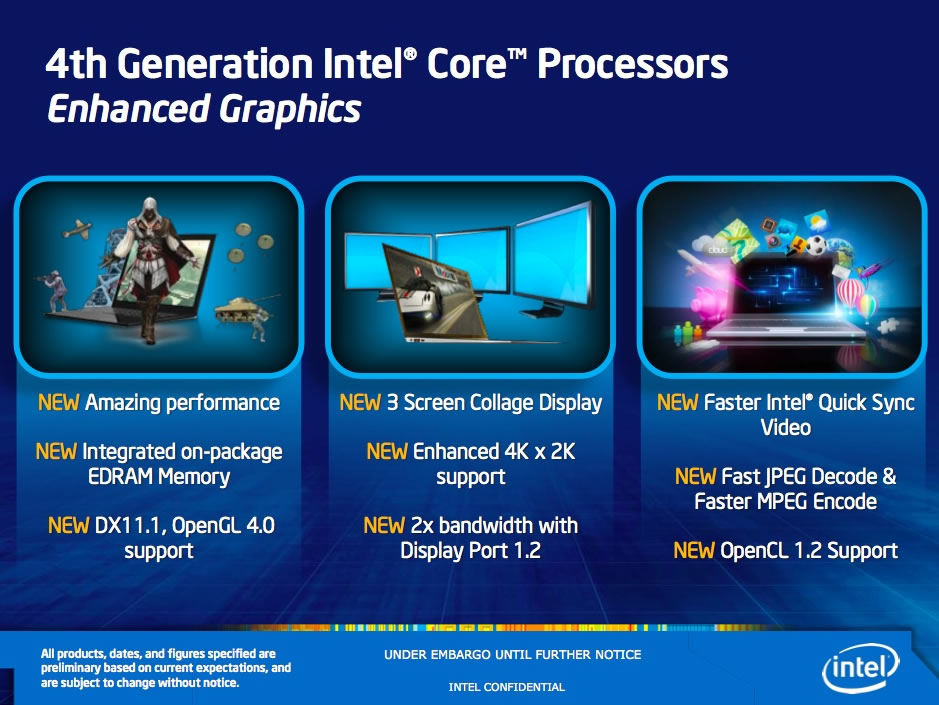
Intel has disclosed new information about its up and coming Haswell processors, detailing the graphics specs and potential performance improvements versus today's integrated HD graphics. Intel is giving the new graphics engine a brand name: "Iris", touting 2x to 3x the performance of HD 4000 graphics.
In the past few months we've come to learn a lot about Haswell. As with Ivy Bridge, efficiency and power consumption have taken priority over raw processing power, and thus Haswell it's expected to be only marginally faster than the current generation of Intel Core CPUs. On the graphics front, however, it's a different story.
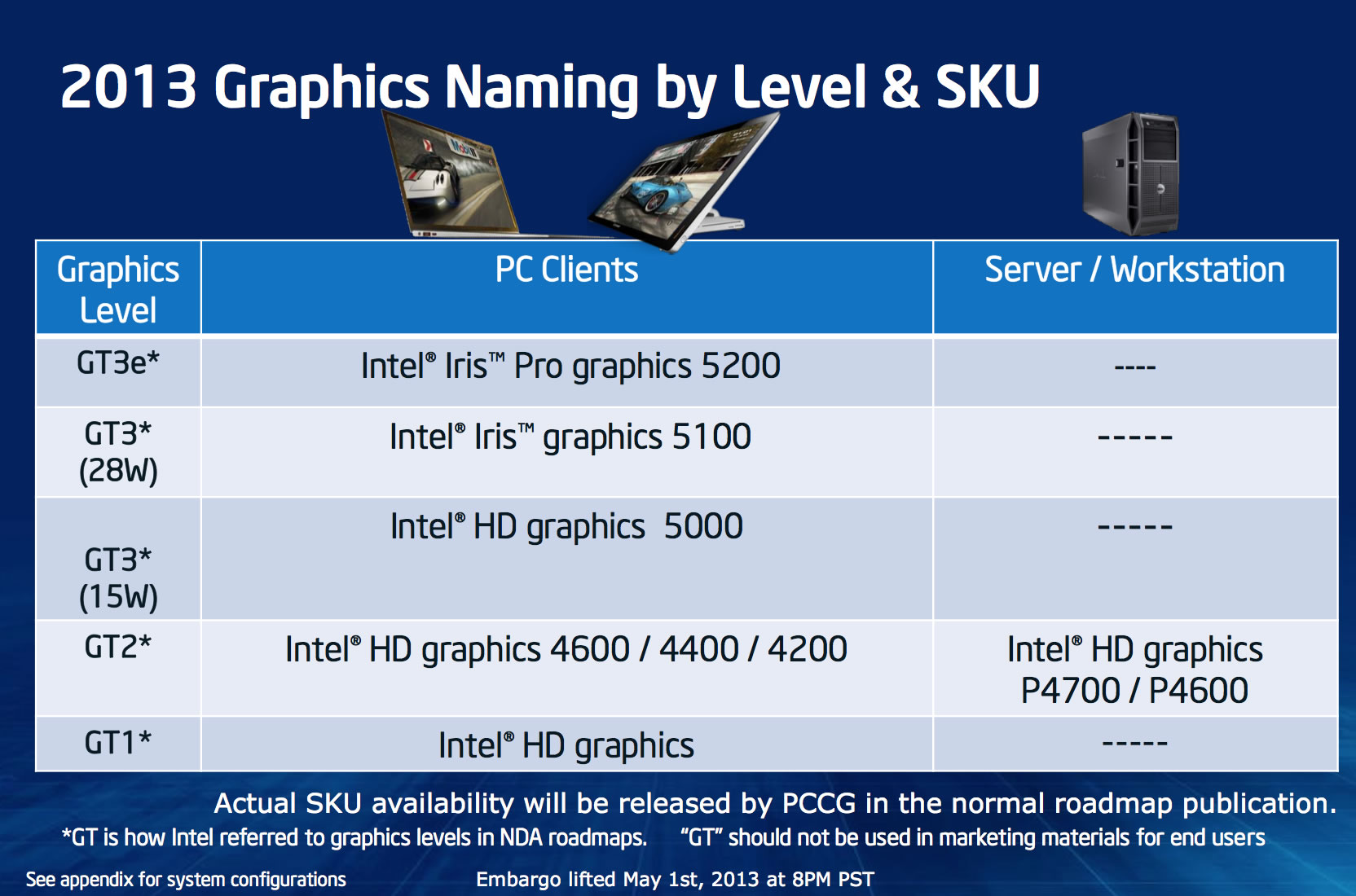
There will be five different graphics configurations, in order of performance: Iris Pro 5200, Iris 5100, HD 5000, HD 4600/4400/4200 and HD graphics. This may become even more confusing that the current line-up, although for the very most part performance-oriented desktop and laptop CPUs simply ship with HD 4000 (the fastest integrated graphics from Intel), while smaller ultrabooks and tablets get the more specialized configurations.
Here's what Intel is expecting from Iris (don't miss our extended note about performance further down below):
Three times the performance of HD 4000 sounds like an amazing feat for a single generational jump. As before, this has the potential to keep eating on the budget discrete GPU market. It's no coincidence AMD and Nvidia have nearly retired the sub $100 graphics cards, since integrated graphics have been able to cope with different kinds of typical workloads (HD video playback, etc.), usually only falling short when it comes to gaming.
When we reviewed Ivy Bridge about a year ago, we tested the Core i7-3770K's on-die GPU performance. The results were disappointing to say the least, but if Intel is able to double or even triple performance, it's going to be a very interesting landscape for PC gaming moving forward.
Starcraft 2 running at 1280x800 (medium quality) on HD 4000. More games here.

Outlook.com migration complete, service hits 400 million active accounts


Microsoft today announced it has completed moving its Hotmail.com users over to Outlook.com, roughly nine months after first taking the wraps off its revamped email service at the end of July 2012. According to the company, there are currently 400 million active Outlook.com accounts, noting that the growing organic excitement over the service helped pushed that number up from “over 300 million” at Hotmail’s peak.
That’s also up from 60 million active accounts when Outlook.com came out of preview in February, and out of the total number of users, there are 125 million that are accessing email, calendar and contacts on a mobile device via Exchange ActiveSync. All in all, 150 petabyes of email data were migrated over the past six weeks.
To celebrate the milestone Microsoft is also rolling out two significant upgrades to the service: SMTP Send and deeper SkyDrive integration. The former streamlines the process of sending email from an alias, including non-Outlook addresses, without recipients seeing a message saying “Sent on behalf of…”.
As for the improved SkyDrive integration, it specifically centers on the message composer, which now allows users to select SkyDrive photos and files from the cloud storage service and automatically turn those into the right thumbnails with links that have the right permissions tied to people that receive the email.
Both new features are rolling out today. Microsoft says SMTP should be available immediately to all users worldwide, while the SkyDrive integration is being rolled out gradually over the next few weeks.

IMAX's Private Home Theater brings the big screen to you


If you’ve got a cool million or two lying around and you want the ultimate in home theater entertainment, look no further than IMAX. The company recently announced plans to offer a select few the opportunity to bring the IMAX experience right to the comforts of their own home via a custom-designed, private home theater.
It’s unclear if the “select few” is in reference to a limited number of installs available or the fact that few could afford to own what IMAX describes as the world’s most immersive and luxurious entertainment experience.
IMAX will design every aspect of the private theater – from their renowned projection and sound technology to the room acoustics and theater geometry – to work as a fully integrated solution optimized specifically for each install. The team works directly with your architects, developers, interior designers and custom installers to ensure everything is built to IMAX’s exacting performance standards while catering to your specific design preferences.
Once the system is installed, there won’t be any further work required on your part. That’s because the system is connected to their Commercial Service Center with 24/7/365 remote monitoring. If something does go down, IMAX promises a response time of less than five minutes. There’s also preventative maintenance, performance tuning and on-the-ground support – all free of charge, of course.
Outside of Hollywood A-listers, we can’t imagine there are too many people that would be willing to throw down this kind of dough for a home theater system. Either way, however, it’s nice to see something like this finally being offered in the home.


Subscribe to our Newsletter

Contact our Support

Email us: techthefuturetimes@gmail.com

Our Team Memebers